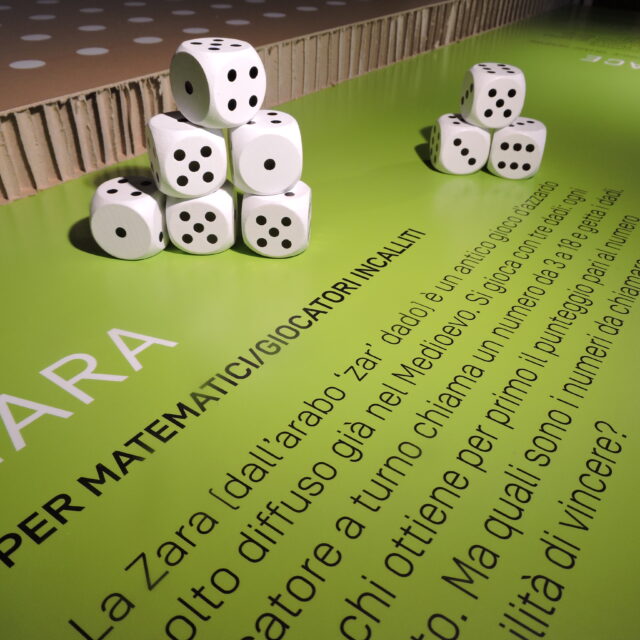
Quando si parte il giuoco della zara, Colui che perde si riman dolente, Repetendo le volte, e tristo impara; Con l’altro se ne va tutta la gente; Qual va dinnanzi, e qual di dietro il prende, E qual da lato li si reca a mente. Ei non s’arresta, e questo e quello intende; A cui porge la man, più non fa pressa; E così dalla calca si difende. Tal era io in quella turba spessa, Volgendo a loro, e qua e là, la faccia, E promettendo mi sciogliea da essa. dante alighieri [Pur, VI, 1-12]
La teoria della probabilità non è in fondo che buon senso ridotto a calcolo; essa permette di valutare con esattezza ciò che le menti illuminate sentono per una specie di istinto senza rendersene conto… E’ notevole come tale scienza, che è cominciata con gli studi dei giochi d’azzardo, si sia elevata ai più importanti oggetti delle conoscenze umane. (The theory of probability is at bottom nothing but common sense reduced to calculation; it makes it possible to evaluate exactly what enlightened minds feel by a kind of instinct without realizing it… It is remarkable how such science, which began with studies of games of chance, has risen to the most important objects of human knowledge). Blaise pascal
How to play
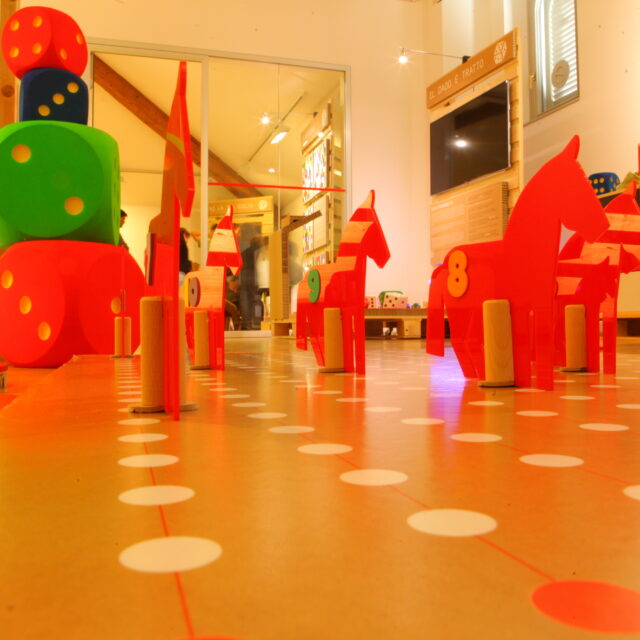
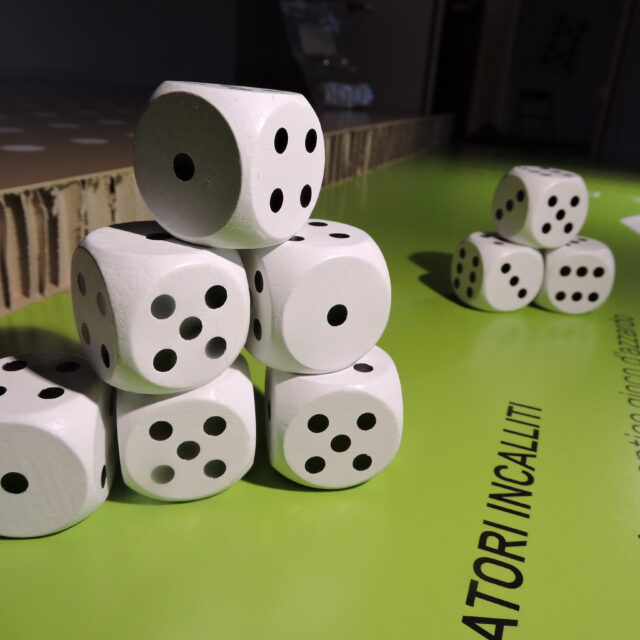
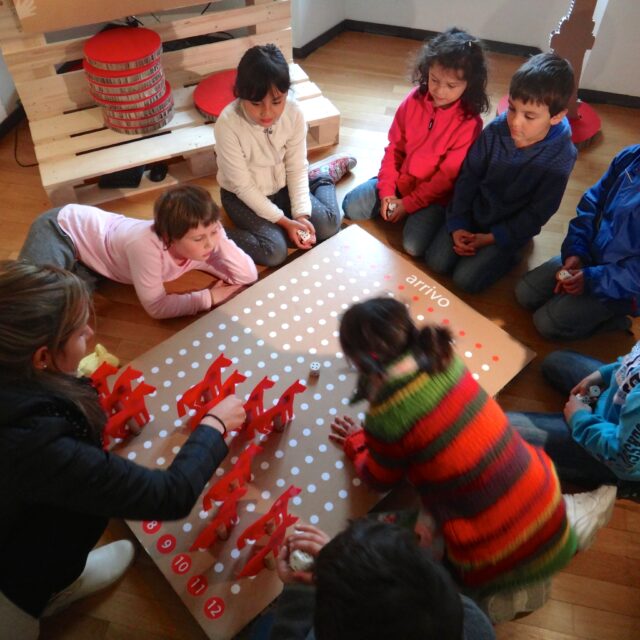
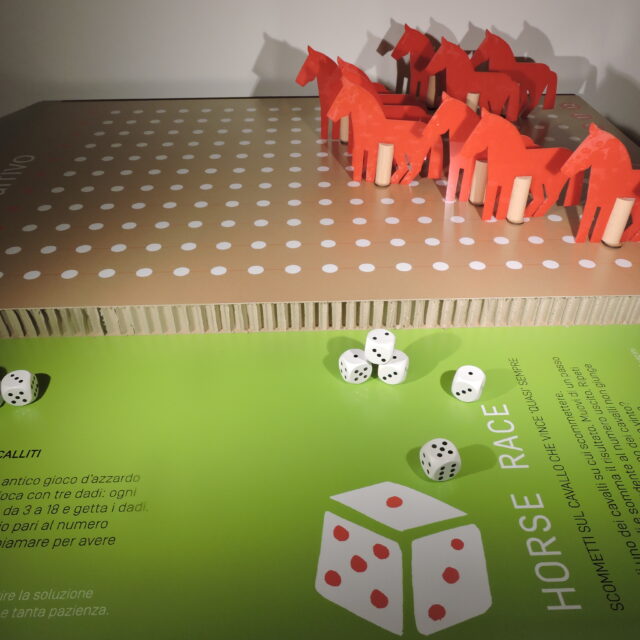
In the game Horse race there are eleven little horses numbered from 2 to 12. The numbers of the little horses correspond to the resul t of the sum of the roll of two dice (each with 6 sides and numbers 1 to 6). The horsies advance one step each time their number comes out as the sum of the two dice rolled, and the dice rolls are repeate d until one of the horses reaches the finish line. Which horse is best to bet on? Which horse is most likely to win? FOR TEACHER FOR SCIENTIFIC EXPLAINER INSIGHTS AND LINKS ASSEMBLY SHEET FOR TEACHER The game highlights how it is not convenient to bet on the horses closest to the extremes i.e. with number 2 or 12 being the slowest ones. In fact, these numbers are less likely to come out since they can only be obtained with a few combinations. For example, horse 11 can only advance with two combinations = 5 + 6 and 6 + 5. Whereas the middle numbers are much more likely to come out. For example 7 = 1+6, 6+1, 2+5, 5+2, 3+4 and 4+3. In total, if you roll two dice-with values from 1 to 6-you can get 6×6=36 results. The frequencies of the possible sums are as follows:- Little horse 2: 1+1 = 1/36
- Little horse 3: 1+2, 2+1 = 2/36
- Little horse 4: 1+3, 3+1, 2+2 = 3/36
- Little horse 5: 1+4, 4+1, 3+2, 2+3 = 4/36
- Little horse 6: 1+5, 5+1, 4+2. 2+4, 3+3 = 5/36
- Little horse 7: 1+6, 6+1, 2+5, 5+2, 3+4, 4+3 = 6/36
- Little horse 8: 2+6, 6+2, 3+5, 5+3, 4+4 = 5/36
- Little horse 9: 3+6, 6+3, 4+5, 5+4 = 4/36
- Little horse 10: 4+6, 6+4, 5+5 = 3/36
- Little horse 11: 5+6, 6+5 = 2/36
- Little horse 12: 6+6 =1/36
- Black horse: black ball + black ball = 1/4
- White horse: white ball + white ball = 1/4
- Gray horse: white ball + black ball, black ball + white ball = 2/4 (50%)
…ancor che il 9 e ‘l 12 in altrettante maniere si componghino in quante il 10 e ‘l 11, per lo che di eguale uso devriano esser reputati, si vede non di meno che la lunga osservazione ha fatto da i giocatori stimarsi più vantaggiosi il 10 e l’11 che ‘l 9 e ‘l 12.Galileo noted that both 10 and 11 “are obtained by the same number of triplicities” (the values visible on the three dice). These triplicities can be of three kinds: those that are made up of 3 equal numbers, which can be obtained in one way, those that arise from 2 equal numbers and the third different one that are produced in 3 ways (e.g., 1.1.2. : triplicity: 1.1.2 can also be obtained with: 1.2.1 and with 2.1.1) and those arising from 3 all different numbers that are formed in 6 manners (e.g.: 1.2.3; 1.3.2; 2.1.3; 2.3.1; 3.1.2; 3.2.1). Thus, counting right, both 10 and 11 can be obtained in twenty-seven different ways (orderings), while 9 and 12 in only twenty-five ways despite having the same number of combinations, i.e., six:(Galileo Galilei, “Sopra le scoperte de i dadi”, probably written in the years between 1612 and 1623)
- 9 [6,2,1]*6 + [5,3,1]*6 + [4,3,2]*6 + [5,2,2]*3 + [4,4,1]*3 + [3,3,3]*1 = 25 sorting
- 10 [6,3,1]*6 + [5,4,1]*6 + [5,3,2]*6 + [4,4,2]*3 + [4,3,3]*3 + [6,2,2]*3 = 27 sorting
- 11 [6,4,1]*6 + [6,3,2]*6 + [5,4,2]*6 + [5,5,1]*3 + [5,3,3]*3 + [4,4,3]*3 = 27 sorting
- 12 [6,5,1]*6 + [6,4,2]*6 + [5,4,3]*6 + [6,3,3]*3 + [5,5,2]*3 + [4,4,4]*1 = 25 sorting
…da questa tavola potrà ogn’uno che intenda il gioco, andar puntualissima- mente compassando tutti i vantaggi, per minimi che sieno, delle zare, de gl’incontri e di qualunque altra particolar regola e termine che in esso giuoco si osserva, etc.A table similar to the one created by Galileo can be found in the figure below:
 ASSEMBLY SHEET
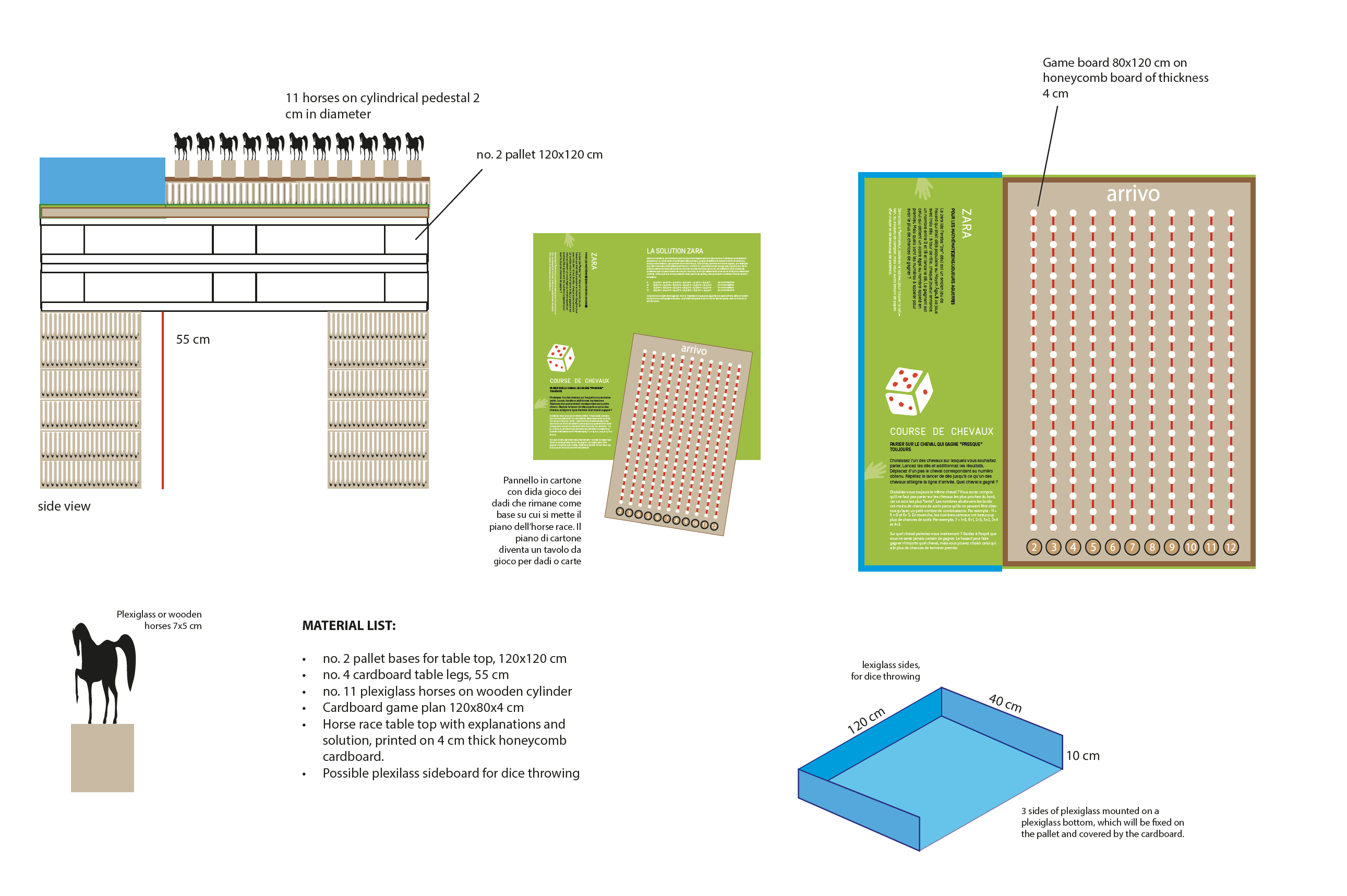
How to build
EXHIBIT MATERIAL:
- Gameboard 120×80 cm
- At least no. 2 regular dice
- no. 11 little horses of the same color
- no. 3 little horses, one white, one black and one gray
- no. 2 pallet 120x120x15 cm
- no. 4 honeycomb cardboard 160x80x5cm (to make 4 table legs, square base 40 cm by 40 cm high).
- GAMEBOARD HORSE RACE (ITA)
- GAMEBOARD HORSE RACE (DE) // dimensions: 120×80 cm // material: laminated honeycomb cardboard for digital printing, 5 cm high.
- PANEL EXHIBIT (DE)
- PANEL EXHIBIT (ITA) // dimension: 120×120 cm // material: laminated honeycomb for digital printing, 5 cm high
- LITTLE HORSE MODEL // for lasercut use.